
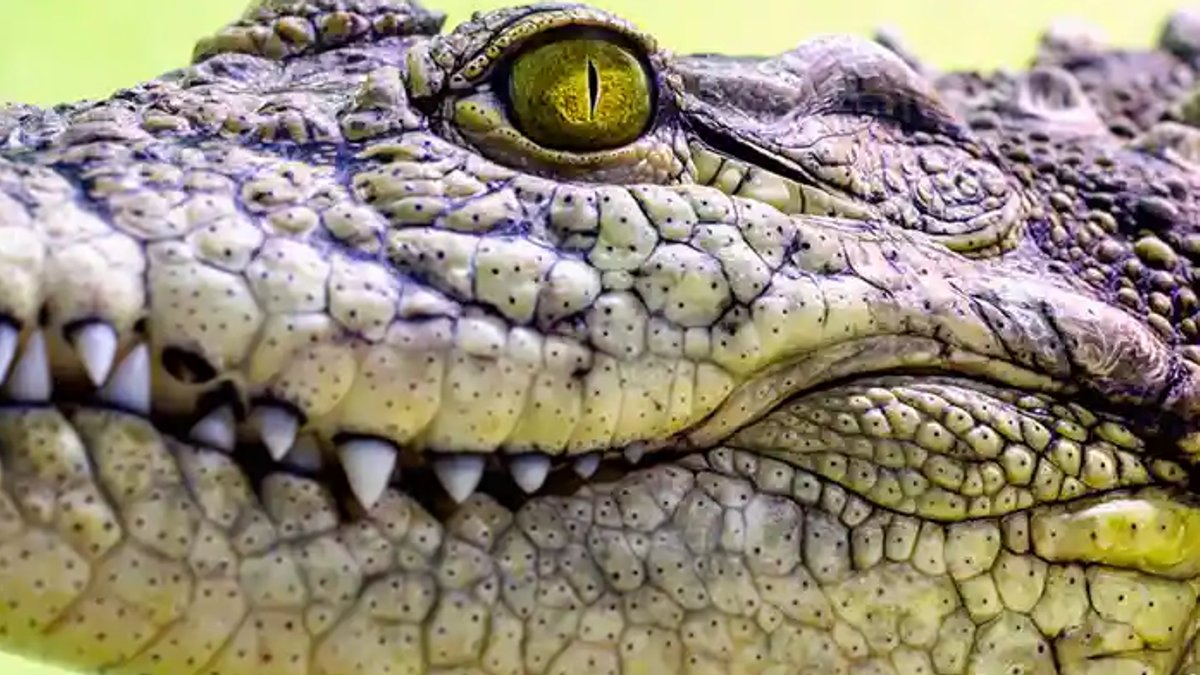
Crocodiles are one of the world’s greatest ambush predators, relying on surprise attacks to catch their prey. They lack the endurance for long chases on land or in the water, so they depend on launching swift attacks on unsuspecting animals. Crocodiles will attack virtually anything for a meal, from zebras and hippos to birds, porcupines, fish, and even people.
Their eyes are uniquely suited for lurking, with a horizontal streak of tightly packed receptors called fovea. This allows them to scan the shoreline for prey without moving their head, giving them a strong advantage in spotting potential meals along the horizon.
Research published in the Journal of Experimental Biology found that crocodile eyes have a horizontal streak of fovea, which provides high-resolution viewing. In humans, the fovea is used to read, but because it only exists in a small area, the eyes need to move to see larger areas.
Related: Aquarium Pets Offer Hidden Health Benefits
Nicolas Nagloo, study author and Ph.D. student at the University of Western Australia, explained that the horizontal streak of fovea in crocodiles gives them maximum clarity all along the visual horizon. This unique feature allows them to spot prey without moving their head, making them highly effective ambush predators.
Overall, crocodile vision is up to seven times less precise than human vision. However, the high-clarity “foveal streak” gives them a strong advantage in finding prey along the horizon. This specialized vision is particularly useful for crocodiles that lie in wait, camouflaged in the water, until an opportunity presents itself.
In addition to their unique fovea, crocodile eyes are also adapted to different water conditions. Saltwater tends to have more blue light while freshwater has more red light. The study found that crocodile eyes corresponded with their habitat’s lighting conditions; freshwater crocs were more sensitive to redder wavelengths of light than saltwater crocs.
Related: Finding the right dog trainer is crucial
Crocodiles are among a select group of species that engage in coordinated hunting efforts. They use coordination and collaboration to catch their prey, often working together to force fish into a tight “bait ball” or scaring animals into a lagoon where other crocodiles are waiting in ambush.
Crocodiles have been able to thrive in their environments for millions of years, and their unique characteristics, such as their specialized vision and coordinated hunting behavior, have played a significant role in their success. This highlights the importance of understanding and appreciating the complex relationships between species and their environments.


