
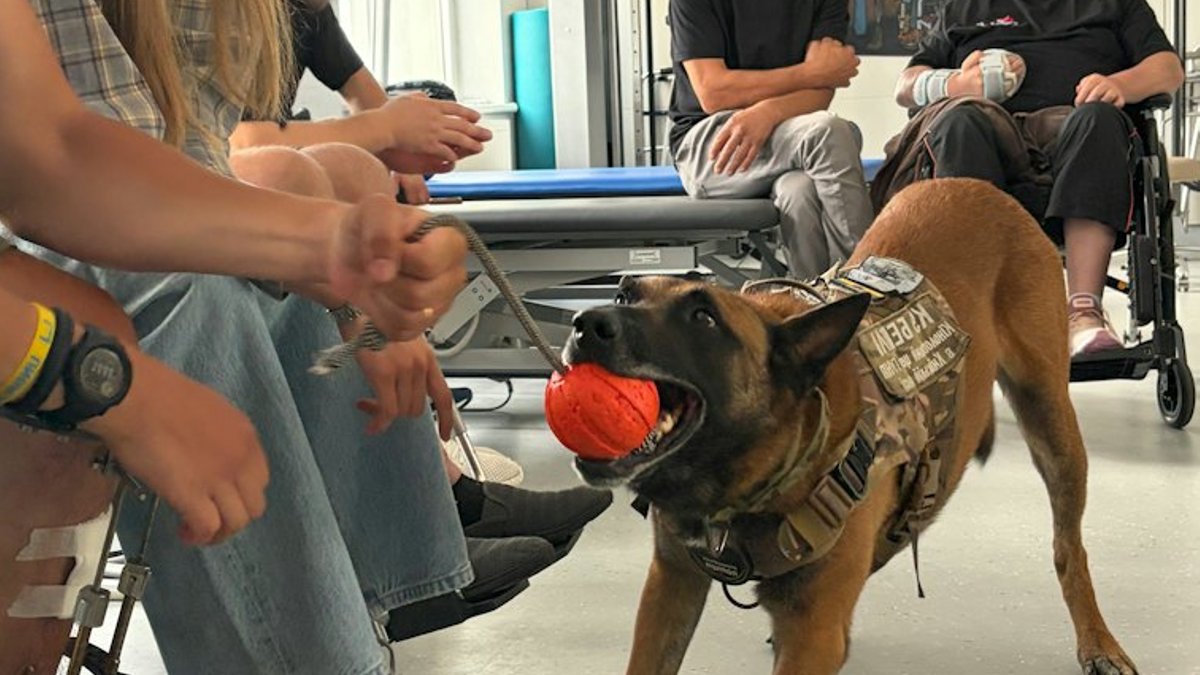
In Lviv, the first participants have begun training as part of Unbroken Animals, a program that provides emotional support to veterans, service members, and their families with the help of dogs. The initiative pairs participants and their dogs to assist patients at the UNBROKEN rehabilitation center in their recovery. The first cohort includes 10 participants and their dogs, undergoing theoretical instruction and practical sessions with veterans under the guidance of dog trainers.
The effort was launched by Kormotech, a Ukrainian technology company, in partnership with U-Hearts, an animal-welfare platform that has already assisted over 300,000 animals since the full-scale war began. The platform, formerly known as Save Pets of Ukraine, has distributed 2,400 metric tons of pet food, provided 31,000 vaccinations, and helped rehome 2,940 animals since 2022.
At the center of the program is the Companions training method, developed by Kateryna Bieliaieva, a senior inspector at the Kyiv Region Police Canine Center. Since 2019, Bieliaieva has used dogs to support people recovering from war trauma, making over 2,000 visits to hospitals, military hospitals, and rehabilitation centers. Her approach focuses on engaging patients emotionally—a need often overlooked in traditional recovery programs.
How dogs ease trauma and rebuild trust
One key insight is that veterans struggling with physical rehabilitation may lose motivation when exercises become painful or difficult. A dog, however, offers companionship without judgment. Iryna Lozova, head of social projects at U-Hearts, explained that interaction with animals can ease tension and encourage veterans to attempt tasks they might otherwise avoid. For example, a participant named Ivan (name changed) feared his prosthetic arm would fail during use. While playing with the dog, his fear faded, and he began practicing movements he had previously avoided.
Related Post: German Dogs Master Multiple Tasks
The selection process for handlers and dogs is rigorous. Only fully vaccinated, non-aggressive animals over two years old are considered. In the first round, organizers received 124 applications before narrowing the field to ten pairs. Participant Ostap Zubach, a traumatologist, joined the effort with his 7-year-old Labrador, Ami. Zubach noted that while medical care addresses physical injuries, emotional recovery remains critical. “For me, this project is an opportunity to complement physical rehabilitation with emotional support,” he said.
Training lasts approximately two months, blending classroom instruction with practical work. Veterans at the UNBROKEN center interact with the dogs, learning to read their behavior while performing simple tasks, such as holding a toy while a dog pulls on it, to rebuild coordination. The program prioritizes the dogs’ well-being, halting sessions if an animal shows discomfort.
Success stories: animals as silent therapists
Bieliaieva shared an example of how dogs can bridge gaps in recovery. A veteran with multiple concussions refused assistance from people but willingly followed a police dog named Vanda, who guided him by his sleeve. The dog’s presence became his motivation to move, even when he resisted human help.
Beyond Lviv, the program plans to expand. A similar recruitment drive for additional pairs is set for Kyiv this fall, with organizers emphasizing the need for scalable solutions. The pilot runs through November 2026, implemented by the NGO Pro Lviv in collaboration with LKP Lev, UNBROKEN, the NGO U-Hearts Ukraine, the Lviv Bureau for European Integration, and the Department of Investments and Projects of the Lviv City Council as part of the U-LEAD with Europe program, which is run with the support of the European Union and its member states: Germany, Denmark, France, Austria, Poland.


